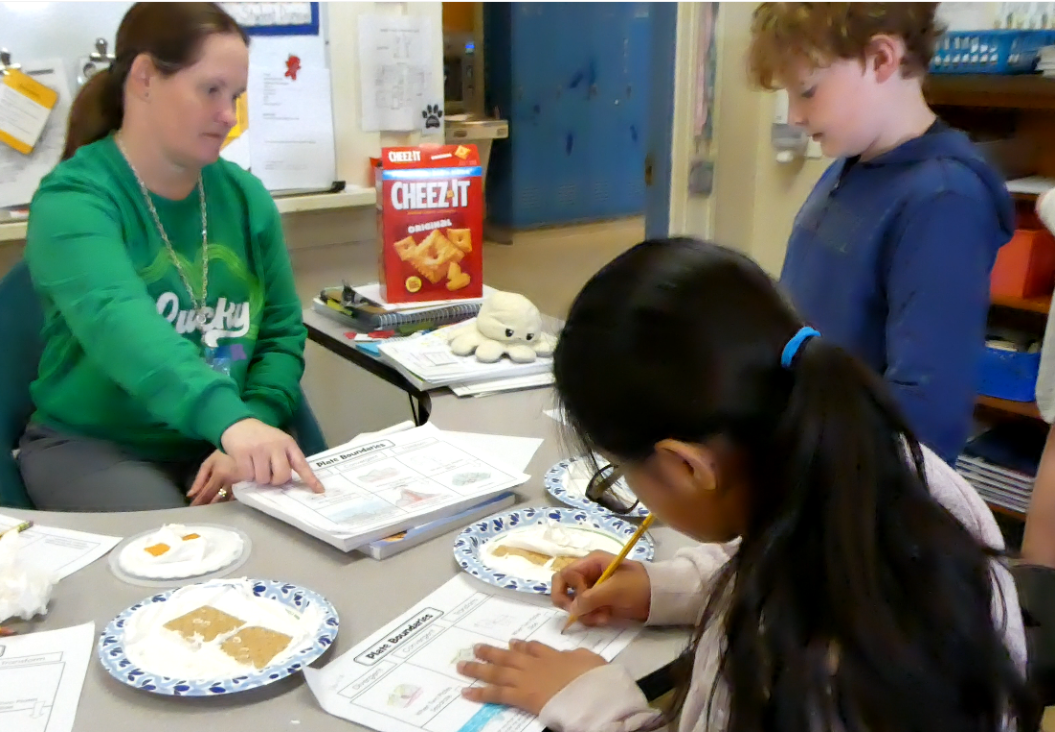
Mrs. Slagle's class embarked on a fascinating journey to understand the dynamic nature of Earth's surface through the study of tectonic plates. Using a creative, tasty approach, the students engaged in a hands-on activity involving Cool Whip and graham crackers to visualize the movement at different tectonic boundaries.
Students learned that tectonic plates are steadily moving an average of three to five centimeters per year due to the convection currents in the underlying mantle. Their interactions at boundaries are responsible for many geological phenomena such as earthquakes, volcanic activity, and the formation of mountain ranges.
To bring the concept to life, Mrs. Slagle chose an activity using everyday items: Cool Whip and graham crackers. Here's how the students explored the different types of plate boundaries:
Convergent boundaries occur when two plates move towards each other. In the activity, students pushed two graham crackers into the Cool Whip, simulating how one plate might slide beneath another, a process known as subduction. This demonstrated how mountain ranges and deep ocean trenches are formed.
For divergent boundaries, where two plates move apart, the students placed two graham crackers side-by-side on the Cool Whip and gently pulled them apart. This activity illustrated the creation of new crust as magma rises to fill the gap, akin to what happens at mid-ocean ridges.
Transform boundaries involve plates sliding past each other horizontally. Students mimicked this by sliding two graham crackers past each other over the Cool Whip, showing how these boundaries can lead to earthquakes due to the friction and stress that builds up between the sliding plates.
By using Cool Whip and graham crackers, Mrs. Slagle's students gained a clearer understanding of the complex movements of tectonic plates. This engaging and interactive method not only made the learning process enjoyable but also helped students memorably grasp the fundamental concepts of Earth's geology. The activity not only catered to visual and tactile learners but also provided a delicious incentive for learning!